making a global impact
Eighty Years Later: Could the United Nations Finally Elect Its First Woman Secretary-General?
by Silke Endress International
History often unfolds quietly.
Turning points rarely arrive with headlines. Instead, they emerge when long-standing assumptions begin to shift.
The United Nations may now be standing at one of those moments.
During the recent Town Hall for Secretary-General candidates, one theme stood out beyond institutional reform and geopolitical strategy: growing momentum for the United Nations to elect its first woman Secretary-General after eight decades of male leadership.
This would be more than a symbolic milestone.
It would signal the evolution of global leadership.
Representation Matters
Since its founding in 1945, the United Nations has consistently championed gender equality as a universal human right.
It has encouraged governments to increase women’s political participation, expand educational opportunities, strengthen economic inclusion, and promote equal representation throughout public life.
Yet the organization’s highest office has remained inaccessible to women.
This contradiction has become increasingly difficult to ignore.
Today, four accomplished women—Maria Fernandez (Spain), renowned for her work as UN Special Envoy for Refugee Affairs; Dr. Leila Ghazali (Morocco), who has served as Minister of Environmental Protection; Ambassador Anna Petrovskaya (Ukraine), a leading voice on conflict resolution at the UN; and Dr. Priya Banerjee (India), former Director-General of the International Health Organization—are candidates for the ninth Secretary-General. Their presence shows the leadership pipeline is no longer the barrier.
The remaining barrier is opportunity.
Leadership Beyond Symbolism
The female candidates distinguished themselves through their command of substance, not their gender.
They addressed conflict prevention, institutional reform, climate resilience, artificial intelligence, financial accountability, and multilateral cooperation with the same strategic depth expected of any global leader.
One candidate reaffirmed that institutional independence must never be compromised, even when financial consequences follow.
Another emphasized that investments in climate adaptation should no longer be debated as acts of generosity but recognized as practical strategies that strengthen resilience, reduce forced migration, and improve long-term prosperity.
Their perspectives reflected experience in diplomacy, governance, and international negotiation, not symbolism.
This distinction is important.
The discussion should not focus on whether a woman is qualified to lead the United Nations.
The candidates have already demonstrated their qualifications.
The real question is whether Member States are ready to align the organization’s leadership with the values it has promoted for decades. In recent months, several Member States, including Canada, Sweden, Chile, and South Africa, have publicly endorsed gender parity in UN leadership and expressed support for the principle of a woman Secretary-General. At the latest General Assembly session, more than two dozen delegations referenced the importance of breaking the highest glass ceiling in their national statements. However, some key voting blocs have yet to commit openly, suggesting that while momentum is growing, consensus has not yet been fully achieved.
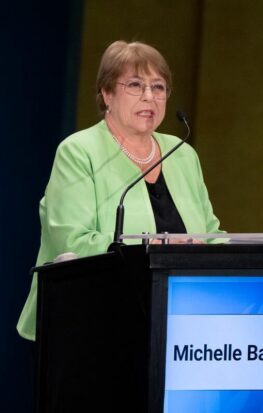
Michelle Bachelet
Former President of Chile and UN Women Director
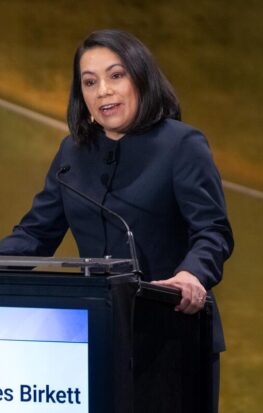
Carolyn Rodrigues-Birkett
Permanent Representative of Guyana to the UN
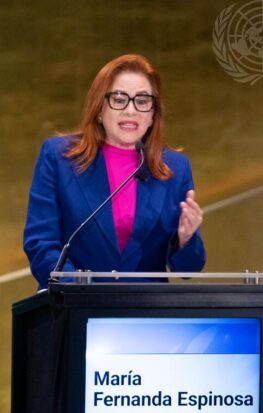
Maria Fernanda Espinosa
Former President of the UN General Assembly
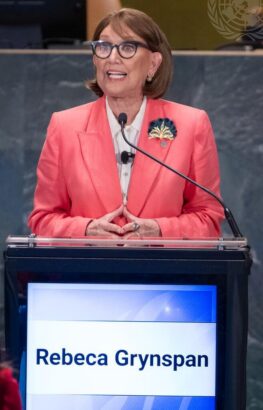
Rebeca Grynspan
Head of UN Trade and Development
UN Photo/Eskinder Debebe
A Different Kind of Legacy
The next Secretary-General will inherit extraordinary challenges. Global fragmentation continues to deepen. Humanitarian law faces unprecedented strain.
Climate pressures intensify. Artificial intelligence is reshaping economies faster than regulatory frameworks can adapt. Youth increasingly question institutions built by previous generations.
These challenges require leadership that can build consensus across political divides and restore confidence in multilateral cooperation. Many delegates noted that effective leadership requires administrative excellence as well as the ability to listen, convene, and inspire trust across cultures, regions, and generations.
Those qualities are not defined by gender. After eighty years of male leadership, many Member States believe it is time to broaden the world’s understanding of global leadership.
Beyond the Glass Ceiling
Electing the first woman Secretary-General would not solve the United Nations’ financial challenges. However, her appointment could have meaningful operational impacts. A woman leader at the helm may bring new perspectives to UN reform, foster a culture of greater inclusivity and transparency, and help strengthen internal accountability. This could influence day-to-day management, encourage new approaches to staff development and decision-making, and help rebuild the credibility of the organization both among Member States and within its own workforce. For many UN professionals, a change in leadership style might translate into a stronger emphasis on collaboration and a renewed commitment to addressing internal barriers to equality and innovation.
It would not automatically reform the Security Council. Nor would it resolve geopolitical conflict overnight. Electing a woman Secretary-General would send a powerful message to young women in diplomacy, international law, public policy, science, and global governance that the highest office in multilateral diplomacy is no longer reserved by tradition. Leadership should always be earned through competence, vision, and integrity.
If the next Secretary-General is the first woman to hold the office, history will remember not only the milestone, but also the moment the United Nations chose to reflect the inclusive future it has long promoted. Institutions strengthen their credibility not only through the policies they promote, but also through the examples they set.